
Weights of the fuel group are set to rise in the revised Wholesale Price Index.
A sharp fall in the prices of fruits and vegetables notwithstanding, inflation rose for the fifth consecutive week to a 28-week high of 5.57 per cent for the week ended December 13.

'The statistical confidence bands of the fan charts of the forecasts will provide a better sense of the potential variability of outcomes.'
Costlier petrol, diesel and food products pushed up inflation to 4.14 per cent during the week ended June 25 but it was much lower than 6.95 per cent a year ago.
Amid stock market crash and global financial crisis causing concern among the investors, a fall in inflation rate definitely comes as a relief.
If the difference between provisional and final wholesale price index (WPI) numbers is taken as a leading indicator, the headline inflation rate, which is hovering around zero, is unlikely to change direction.
After falling for ten consecutive weeks, inflation stood unchanged at the previous week's level of 5.01 per cent for the week ended February 12 even though vegetables and fruits became costlier.
Inflation fell below the 6 per cent mark, after almost seven months, to 5.78 per cent during the week ended January 1, mainly due to a fall in prices of fuels, vegetables and fruits, edible oils and other food items.

The decline could also be attributed to the high inflation figure of 18.56 per cent for the corresponding year-ago period, a phenomenon dubbed the 'high base effect' in economic parlance.
Inflation remained static at 7.1 per cent during the week ended October 16 despite rise in prices of fuel and manufactured products.
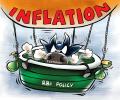
With pricing power of producers unlikely to strengthen and commodities ex-crude oil likely to remain sluggish in the immediate term, the core-WPI inflation may remain sub-zero in the rest of this calendar year.
Tea prices in the country could go up between Rs 10-20 a kilogram if the high level of value added tax (VAT) proposed to be levied on the commodity is not reversed, the industry has warned.

A good wheat crop this season is likely to ease the near double digit inflation in the next 2-3 months, Planning Commission Deputy Chairman Montek Singh Ahluwalia said on Wednesday.

The RBI's projection for WPI inflation for this fiscal is 5.5 per cent.
Food inflation, as measured by the Wholesale Price Index, stood at 9.13 per cent during the previous week.
It was almost 23 per cent during the second week of June, 2010.
The current fiscal began with inflation rising to 5.26 per cent during the week due to costlier food, fuel and manufactured products.
Inflation rose for the fifth consecutive week to 5.89 per cent during the week ended June 12, mainly due to rise in prices of fruits and vegetables, tea, eggs, minerals and manufactured products.
Inflation pierced the 5 per cent mark for the first time this fiscal for the week ended May 22 mainly due to a whopping 9 per cent rise in prices of vegetables and a moderate hike in the prices of other commodities like wheat, eggs and sugar.
While existing investments pipelines are on course, newer projects, which are at conceptual stage, may be affected; companies are concerned that high inflation (the wholesale price index is above 12.6 per cent, a 16-year high) and high interest rates would dampen consumer demand growth, Confederation of Indian Industry President K V Kamath said after a meeting of industry leaders with Finance Minister P Chidambaram.
The inflation fell for the second consecutive week, dropping by 0.06 per cent to 4.2 per cent for the week ended May 1 mainly due to cheaper vegetables, fruits, milk, maida and atta.
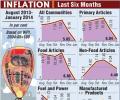
This is the second straight month of decline in wholesale price based inflation.
In line with government's promise to keep commodity prices under check, inflation fell for the fourth consecutive week to 4.30 per cent for the period ended March 20, well within the 4-4.5 per cent forecast by the finance ministry.
Cheaper fruits, vegetables and edible oils pushed down inflation further to 4.78 per cent for the week ended March 13 despite costlier milk, skimmed milk powder, bread and buns, and baby food.
Inflation fell marginally for the second consecutive week to 6.12 per cent for the week ended January 24 notwithstanding the rising prices of some food and non-food articles and majority of manufactured products.

'We will be very, very proactive in providing whatever liquidity requirements are needed.'
There is little to suggest inflation levels will come down since you hardly see the same levels of seasonality in prices that were there earlier.

If the pattern over the last three months is going to continue, the likelihood is that both indices will register inflation rates close to current levels over the next few months.
Inflation rate breached the 5.0 per cent mark during the week ended November 1, after a short span of 14 days, as food articles, fuel, and manufactured products became costly.

RBI has cut policy rate thrice during 2015.

The RBI's rate-setting panel MPC on Monday began its three-day deliberation amid expectations of another round of hike in benchmark interest rates to contain inflation that continues to remain above the central bank's upper tolerance level. RBI Governor Shaktikanta Das will announce the decision of the Monetary Policy Committee after deliberations on Wednesday. Das has already indicated that there may another hike in the repo rate, though he refrained from quantifying it.
Inflation stood unchanged for the second consecutive week at 4.4 per cent for the week ended April 17 despite vegetables and tea prices skyrocketing and a marginal hike in some of the manufactured products, including cement.

To be out by October, it reflects weight of components in GDP.
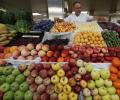
Inflation in food articles was at 0.87 per cent in April 2018, as against a deflation of 0.29 per cent in the preceding month.
Inflation rose marginally to 3.75 per cent during week ended September 17 from 3.53 per cent a week ago, mainly due to increase in the prices of minerals, manufactured products and non-food essential items.
Inflation declined for the fourth consecutive week ended May 21 to 5.38 percent mainly due to cheaper primary articles, including food and fuel products, even as fears that it could spurt looms large over an imminent price hike in fuels.
Inflation touched 5.48 per cent for the week ended April 9, mainly due to costlier vegetables, fruits, cooking gas and edible oils.
